During the effort

Isotonic

An isotonic drink powder. 34 g of carbohydrates and 235 mg of sodium in 500 ml.

An isotonic drink powder. 35 g of carbohydrates and 235 mg of sodium in 500 ml.

An isotonic drink powder. 35 g of carbohydrates and 235 mg of sodium in 500 ml.

4,8/5 8 ratings, 13 reviews
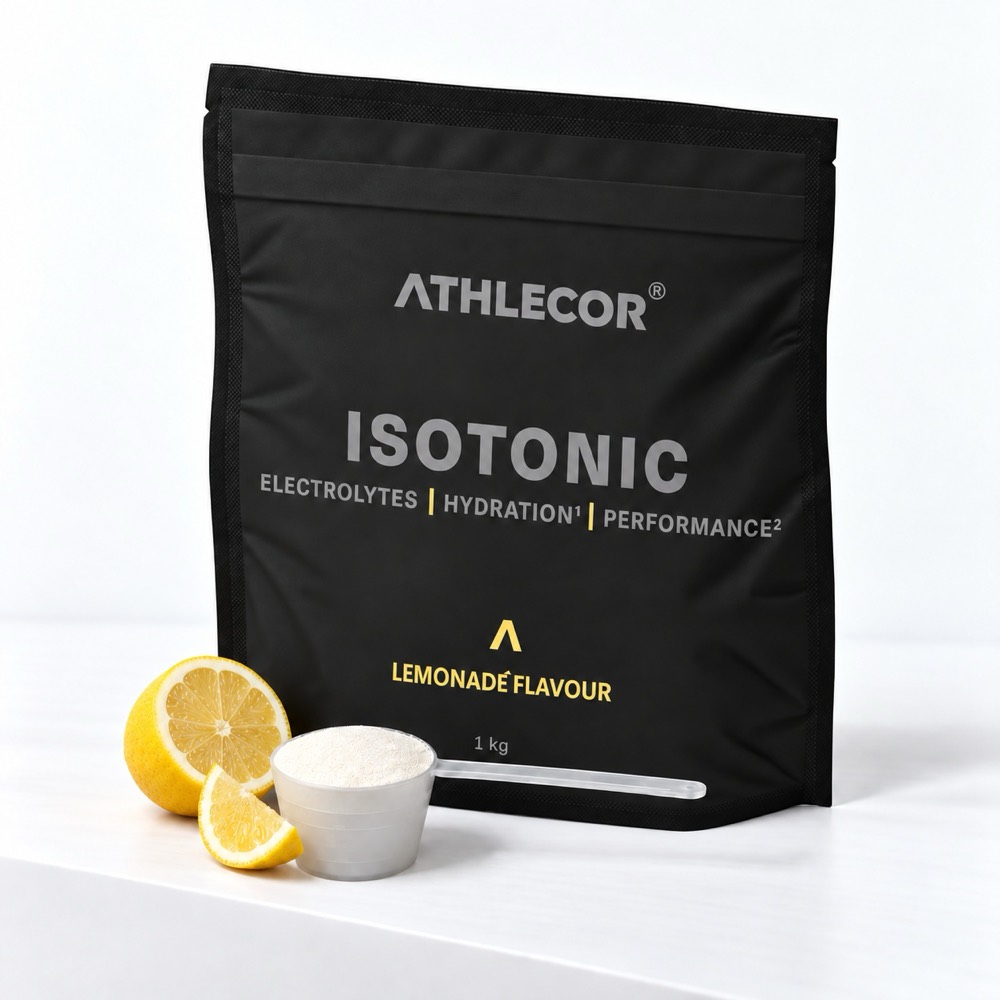
Worek Isotonic 1 kg, smak lemoniada

Swipe the gallery or pick a thumbnail.

Working preview: the model rotates and zooms, and materials in the browser differ from the photo. Your purchase does not depend on this preview.

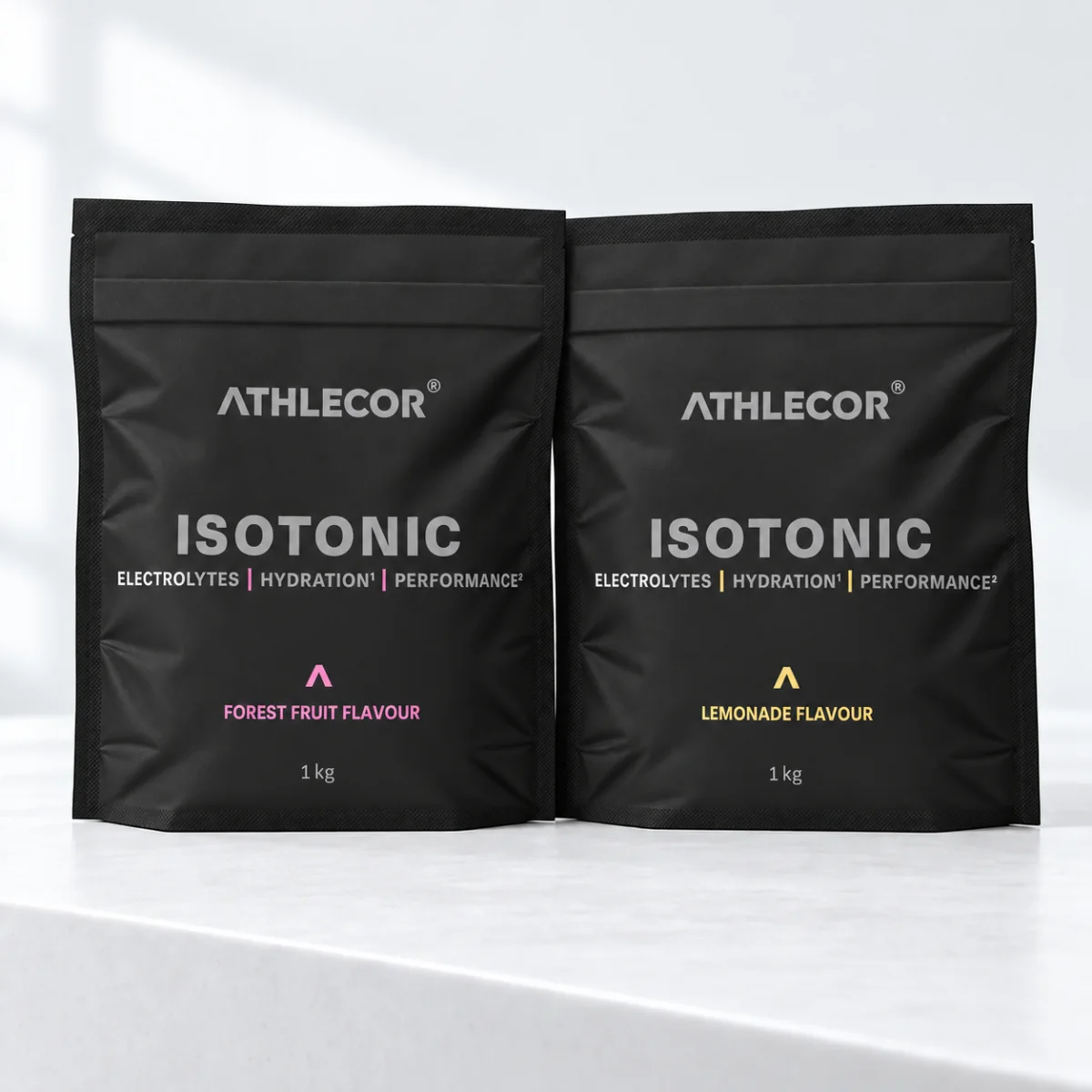
Choose a flavour

Sweetness 1 of 3, acidity 2 of 3. The least sweet of the three flavours.

1 kgpack
25 servingsof 40 g, one scoop per 500 ml; up to 3 servings a day
34 g of carbohydratesper serving
235 mg of sodiumper serving, which is 470 mg per litre
1 kgpack
25 servingsof 40 g, one scoop per 500 ml; up to 3 servings a day
35 g of carbohydratesper serving
235 mg of sodiumper serving, which is 470 mg per litre
1 kgpack
25 servingsof 40 g, one scoop per 500 ml; up to 3 servings a day
35 g of carbohydratesper serving
235 mg of sodiumper serving, which is 470 mg per litre
79 zł3,16 zł per serving over 25 servings

In stock, shipped by 14:00 on business days. Free delivery from 290 zł, below that InPost or DPD, with the cost shown at checkout before you pay.

A food supplement complements your diet. It does not replace varied nutrition or a healthy lifestyle.

supported by AI

Is this for you?

See whether Isotonic fits your training.

A few questions about your training and diet. You see the result right away, without giving an email: whether this product makes sense in your plan, in what serving and when to take it.

Check in the survey

Why this product

40 g per 500 ml. Measured, not declared.

Three decisions in this powder: a ratio that is easy to measure, sodium stated as sodium, and osmolality checked in a laboratory.

40 g per 500 ml of water

One scoop per bottle. 34 g of carbohydrates from maltodextrin, fructose and glucose, of which 15 g are sugars; 135 kcal per serving.

One scoop per bottle. 35 g of carbohydrates from maltodextrin, fructose and glucose, of which 15 g are sugars; 138 kcal per serving.

One scoop per bottle. 35 g of carbohydrates from maltodextrin, fructose and glucose, of which 15 g are sugars; 139 kcal per serving.

Worek Isotonic 1 kg, smak lemoniada

235 mg of sodium per serving

That is 470 mg of sodium per litre of drink. We state sodium, not salt: 0.59 g of salt per serving is the same amount written differently.

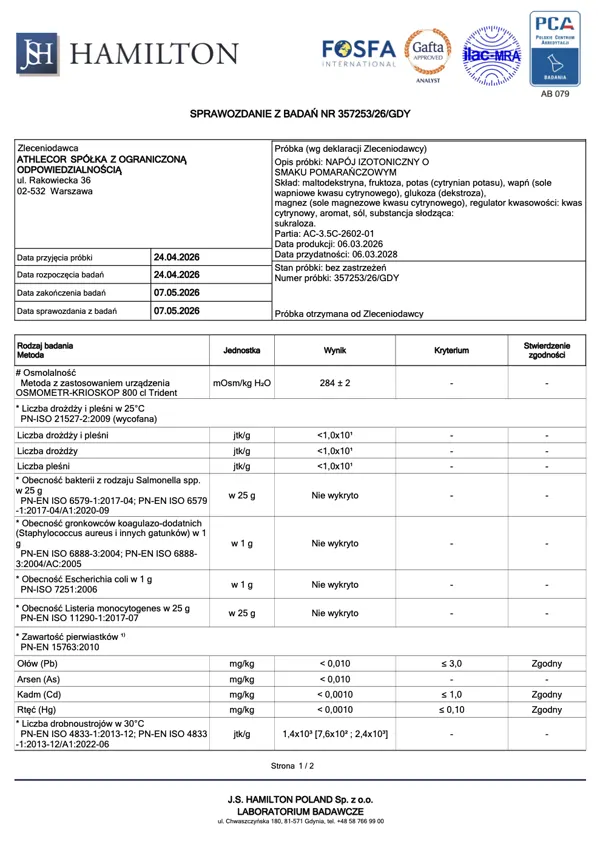
Osmolality 284 mOsm/kg

Measured at the J.S. Hamilton laboratory for the orange flavour, report 357253/26/GDY, cryoscopic method. For the other flavours the result is not in the reports.

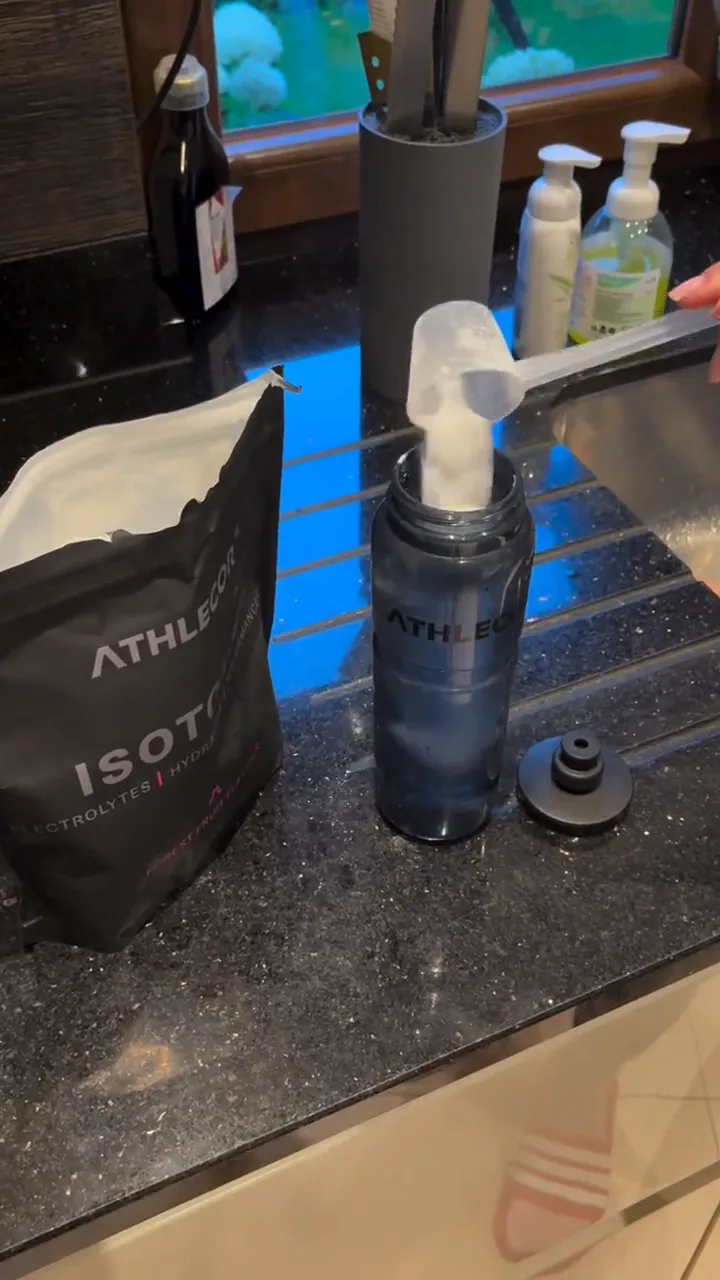
Natalia Dominiak wsypuje miarkę Isotonic do bidonu przed jazdą na rowerze

In use

Before a ride: a scoop into the bottle, 500 ml of water.

Natalia Dominiak, modern pentathlon, making Isotonic before a bike session. A bag, a scoop, a bottle and tap water. That is all it takes.

A frame from Natalia Dominiak's Instagram reel (an athlete who works with ATHLECOR).

During training

Isotonic

A drink for the effort itself
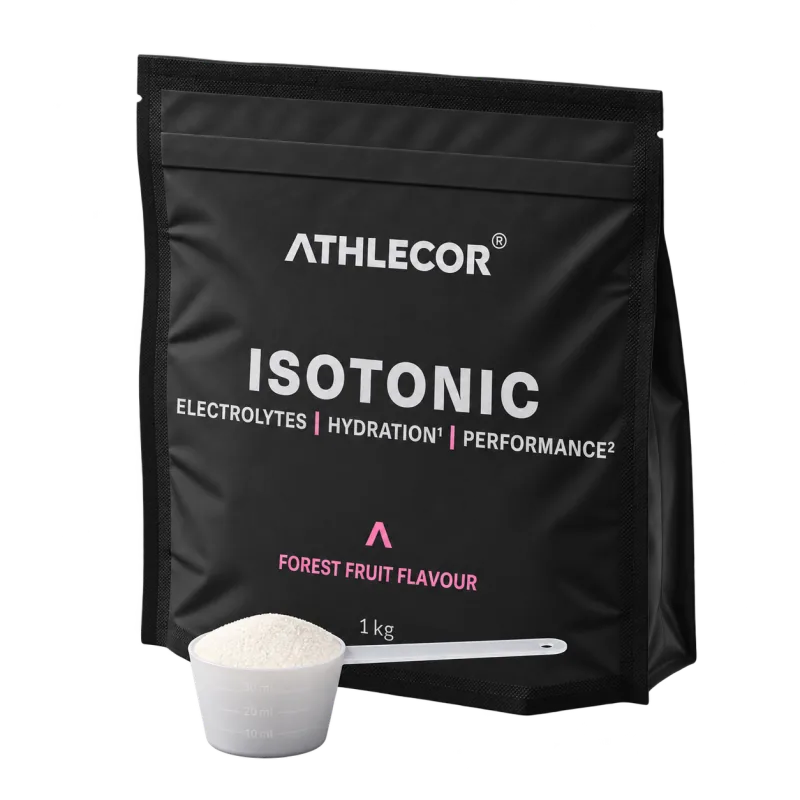
Opakowanie Isotonic
How much40 g of powder

1 scoop according to the current product page.

WhenDuring exercise

Especially long, intense or in the heat.

How500 ml of water

Shake for 10 to 15 seconds. Drink in small amounts.

In practice

Keep the ratio of powder to water. More powder in the same water changes the concentration of the drink.

Match the amount of fluid to the conditions and to how much you sweat. Do not exceed the serving stated on the label.

Worth knowing

Do I need it for every session?

No. For short, easy sessions water is enough. Judge the need for carbohydrates and sodium by duration, intensity and temperature.More in the guide (in Polish): Woda, izotonik czy napój energetyczny: co pić podczas wysiłku

Can I make the drink stronger?

Stick to 40 g per 500 ml. A higher concentration changes the drink and more often upsets the stomach.

How much drink per hour?

A working range is 400 to 800 ml per hour. Match the amount to your sweat rate, the weather and your pace. Do not drink beyond need just to meet a table.More in the guide (in Polish): Żele, napój i jedzenie podczas wysiłku: policz węglowodany i płyny osobno

How many carbohydrates per hour of effort?

30 to 60 g per hour for efforts of 1 to 2.5 hours, 60 to 90 g for longer ones. The 90 to 120 g range needs preparation and a separate assessment. Count carbohydrates from the drink, gels and food together.More in the guide (in Polish): Żele, napój i jedzenie podczas wysiłku: policz węglowodany i płyny osobno

How do I combine the drink with gels or bars?

Add up carbohydrates from every source. 500 ml of the drink made with 40 g of powder is 35 g, a gel adds 25 g, so 60 g together. Plan fluids separately.More in the guide (in Polish): Żele, napój i jedzenie podczas wysiłku: policz węglowodany i płyny osobno

What is gut training?

Testing step by step in training how much drink and how many carbohydrates you tolerate. Do not start with the largest serving and do not try a plan for the first time on race day.More in the guide (in Polish): Trening jelita: jak sprawdzić napój, żele i smak przed zawodami

Can the drink cause stomach problems?

Yes. It usually comes down to the serving, the concentration or your own tolerance. Prepare it to the stated ratio and test it in training. Do not treat recurring complaints as normal.More in the guide (in Polish): Trening jelita: jak sprawdzić napój, żele i smak przed zawodami

What about long races?

Plan fluids and carbohydrates from all products together. Test the strategy in training first.

Based on materials prepared by an Olympic dietitian.
Edited by ATHLECOR.
Sources and how current these instructions are
Tested product batch: AC-3.5A-2602-01.Servings follow the product label and the shop page. If they differ, the label on your pack applies.
supported by AI

Does this product fit you?

Answer questions about your training, diet and body mass. See whether the product fits your needs and how to place it in your plan.

You see the result without buying and without giving an email.

Check in the survey

We are on the other side.

Something unclear?

Write which product you have and what you want to ask. We answer on WhatsApp and by email.

Ingredients without guesswork

Check your serving.

Data for the selected variant. Each table states its basis: a serving or 100 g.

Nutrition facts

Basisper 100 gper 40 g serving
Energy339 kcal135 kcal
Fat0 g0 g
Carbohydrates85 g34 g
of which sugars36 g15 g
Protein0 g0 g
Salt1,5 g0,59 g
Potassium249 mg100 mg
Calcium134 mg53 mg
Magnesium50 mg20 mg

Table from the label of the lemonade variant. A 40 g serving is one scoop per 500 ml of water; the label also gives a daily serving of 3 × 40 g and „about 24 servings” per pack (1000 ÷ 40 = 25).

Basisper 100 gper 40 g serving
Energy345 kcal138 kcal
Fat0 g0 g
Carbohydrates86 g35 g
of which sugars38 g15 g
Protein0 g0 g
Salt1,5 g0,59 g
Potassium249 mg100 mg
Calcium134 mg53 mg
Magnesium50 mg20 mg

Table from the label of the forest fruit variant. A 40 g serving is one scoop per 500 ml of water; 0.59 g of salt per serving equals 235 mg of sodium. The label also gives a daily serving of 3 × 40 g and „about 24 servings” per pack (1000 ÷ 40 = 25).

Basisper 100 gper 40 g serving
Energy346 kcal139 kcal
Fat0 g0 g
Carbohydrates87 g35 g
of which sugars35 g15 g
Protein0 g0 g
Salt1,5 g0,59 g
Potassium249 mg100 mg
Calcium134 mg53 mg
Magnesium50 mg20 mg

Table from the label of the orange variant. A 40 g serving is one scoop per 500 ml of water; the label also gives a daily serving of 3 × 40 g and „about 24 servings” per pack (1000 ÷ 40 = 25).

Full ingredient list and allergens

Lemonade:maltodextrin, fructose, potassium (potassium citrate), calcium (calcium salts of citric acid), glucose (dextrose), magnesium (magnesium salts of citric acid), flavouring, acidity regulator: citric acid, salt, sweetener: sucralose

Allergens in the recipe: none. Label warning: the product may contain milk, soy, peanuts, gluten-containing cereals and eggs.

Forest fruit:maltodextrin, fructose, potassium (potassium citrate), calcium (calcium salts of citric acid), glucose (dextrose), magnesium (magnesium salts of citric acid), flavouring, acidity regulator: citric acid, salt, sweetener: sucralose

Allergens in the recipe: none. Label warning: the product may contain milk, soy, peanuts, gluten-containing cereals and eggs.

Orange:maltodextrin, fructose, potassium (potassium citrate), calcium (calcium salts of citric acid), glucose (dextrose), magnesium (magnesium salts of citric acid), flavouring, acidity regulator: citric acid, salt, sweetener: sucralose

Allergens in the recipe: none. Label warning: the product may contain milk, soy, peanuts, gluten-containing cereals and eggs.

Sources
  • Jeukendrup A., 2014, a review of carbohydrates during exercise (30 to 60 and 60 to 90 g per hour).A Step Towards Personalized Sports Nutrition: Carbohydrate Intake During Exercise. Sports Medicine 44 (Suppl 1):25. DOI
  • Viribay A. et al., 2020, a study of 120 g of carbohydrates per hour in trained runners during a mountain marathon.Effects of 120 g/h of Carbohydrates Intake during a Mountain Marathon on Exercise-Induced Muscle Damage in Elite Runners. Nutrients 12:1367. DOI
  • Maughan R. et al., 2018, the International Olympic Committee consensus statement on supplements.IOC consensus statement: dietary supplements and the high-performance athlete. British Journal of Sports Medicine 52:439. DOI
  • J.S. Hamilton Poland report 357253/26/GDY: osmolality of the orange-flavoured drink, 284 ± 2 mOsm/kg (that variant only).

The links lead to the publication records (DOI or PubMed).

A document you can open

Batch testing.
A defined scope.

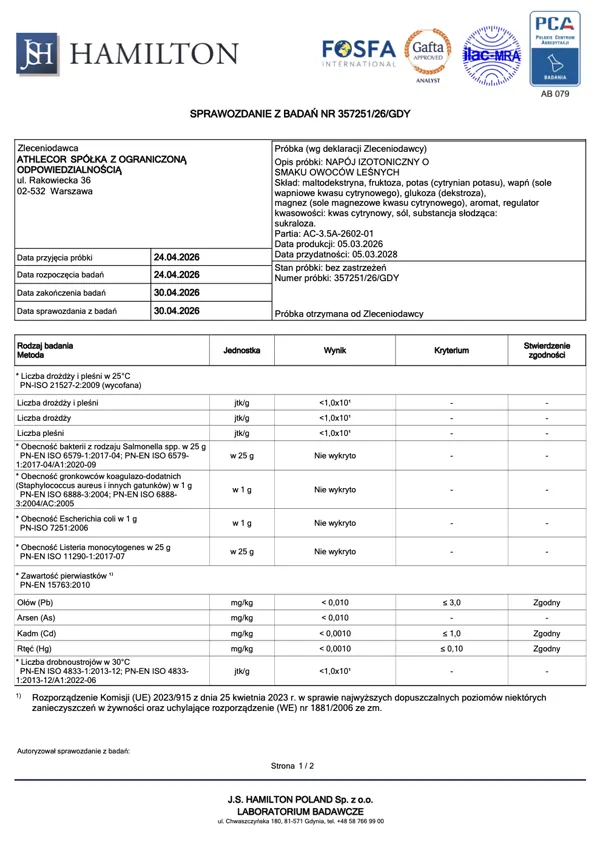
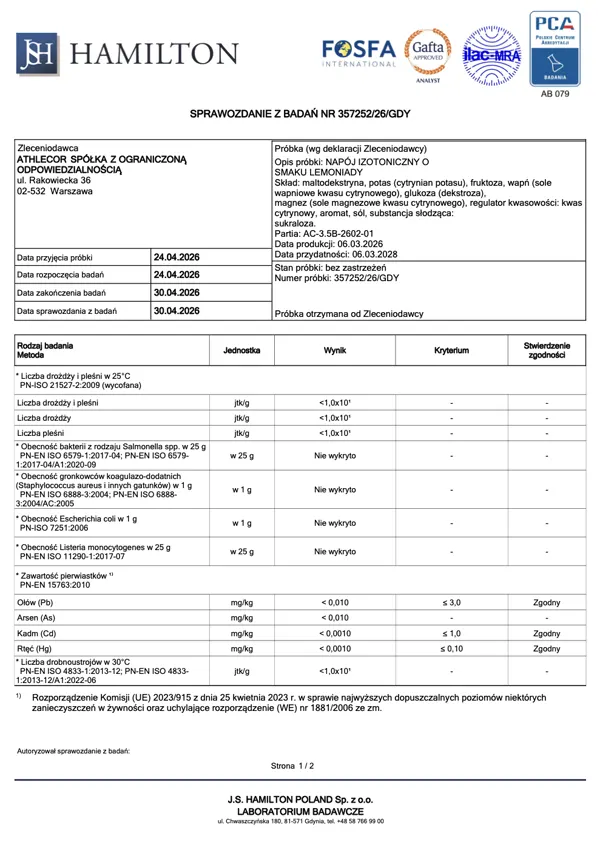
Skan sprawozdania 357252/26/GDY
Skan sprawozdania 357251/26/GDY
Skan sprawozdania 357253/26/GDY

Report by J.S. Hamilton Poland (accredited laboratory, AB 079) no.357252/26/GDY, batchAC-3.5B-2602-01, variant: lemonade. Produced 06.03.2026, best before 06.03.2028.

Report by J.S. Hamilton Poland (accredited laboratory, AB 079) no.357251/26/GDY, batchAC-3.5A-2602-01, variant: forest fruit. Produced 05.03.2026, best before 05.03.2028.

Report by J.S. Hamilton Poland (accredited laboratory, AB 079) no.357253/26/GDY, batchAC-3.5C-2602-01, variant: orange. Produced 06.03.2026, best before 06.03.2028.

What was tested?

Scope: yeasts and moulds, Salmonella, coagulase-positive staphylococci, Escherichia coli, Listeria monocytogenes, and lead, arsenic, cadmium and mercury against Regulation (EU) 2023/915. Metals: within the criterion; micro-organisms below the limits of quantification. The report does not test how well the product works.

What this report does not prove

It is not a study of how well supplementation works, nor an anti-doping certificate. It describes the tested sample from the stated batch.

Thumbnail: page 1 of 2. Compare the batch number with your pack. Tap to open the scan enlarged.

How the formula is built and who decides about it

What customers say

How does it work day to day?

4,8/5 8 ratings, 13 reviews

Reviews in the authors' own wording, written in Polish. The average comes from reviews with a rating. Only reviews linked to an order in the shop carry the „verified purchase” mark.

09.08.2026

Testowałam na długich wybieganiach i naprawdę daje radę. Dla mnie owoce leśne za słodkie, zdecydowanie wolę te cytrusowe.

Aleksandra Szymańska

16.06.2026

Razem z mężem zgodnie twierdzimy że to najlepszy izotonik jaki próbowaliśmy :) polecamy wszystkim znajomym

Julia Kaczmarek

03.06.2026

Lemon jest świetny owoce leśne trochę słodkawe, ale dopracuję ilość w bidonach. Codziennie zresztą na nich robię trening, fajnie, że Izo ma dużo węgli, czuć, że bardzo dobrze nawadnia.

Łukasz Zdanowski

28.05.2026

Znajoma poleciła mi smak owoce leśne i się nie zawiodłam. New fav <3

Martyna B

28.05.2026

owoce lesne najlepsze, 2 torba za mna

Mikołaj K

28.05.2026

normalnie nie lubie pomaranczy ale ta nie jest taka chemiczna tylko przyjemna

robert

Show all reviews (13)
27.05.2026

Smak owoce leśne to jest topka. Jak ktoś nie próbował to polecam

Maciek

21.05.2026

Nie wiem od czego zaczac. Wszystko jest tak jak nalezy; smak sie nie nudzi, nie jest za slodki, za kwasny, za gorzki. W punkt. Wybrałem lemoniadę i się nie zawiodłem.

Hubert

21.05.2026

Normalnie nigdy nie wybieram pomarańczy, ale ta od Athlecor jest zupełnie czyms innym. Smakuje mega; polecam sprobowac <3

Julia Mróz

21.05.2026

Smak owoce leśne co prawda smaczny ale paczka nie zdążyła przyjść przed moim obozem treningowym

Eryk

Na dłuższych treningach na szosie robi robotę. Dobry smak, nie zamula i nie mam po nim problemów z żołądkiem.

Kris

Super izotonik, próbowałem wielu, ale wszystkie miały taki sztuczny posmak, albo były przesłodzone.

Mario

Dobrze siada przed i w trakcie mocnego treningu, nie zalega na żołądku. Minusem jest to, że trzeba pilnować odpowiedniego rozcieńczenia, za mocny robi się dla mnie za słodki.

Klaudia

Good to know before buying

Have a question?

Answers useful before buying and while using the product.

Water delivers fluid. Isotonic also delivers carbohydrates and electrolytes. For a short, easy session water is usually enough. A longer or intense effort may also need energy and sodium planned in.More in the guide (in Polish): Woda, izotonik czy napój energetyczny: co pić podczas wysiłku

Isotonic is there to make a drink with carbohydrates and electrolytes. Energy drinks often contain caffeine and have a different recipe. Check the specific ingredient list, because not every energy drink has the same properties.More in the guide (in Polish): Woda, izotonik czy napój energetyczny: co pić podczas wysiłku

Lemonade is the least sweet, forest fruit the sweetest and least sharp, and orange sits in between. Try the flavour during training too: when you are tired you may prefer something different than at home.More in the guide (in Polish): Trening jelita: jak sprawdzić napój, żele i smak przed zawodami

By recipe, Isotonic contains no caffeine. If you take caffeine separately, you set its amount independently of the drink. The absence of caffeine is not a promise that the product will never affect sleep.More in the guide (in Polish): Woda, izotonik czy napój energetyczny: co pić podczas wysiłku

During exercise, carbohydrates can be a planned source of energy. That does not make a sweetened drink necessary all day. Allow for your whole diet, the length of the session and oral hygiene.More in the guide (in Polish): Woda, izotonik czy napój energetyczny: co pić podczas wysiłku

Frequent contact with sugar and an acidic drink can favour caries and enamel erosion. Use the drink as your training needs it, rinse your mouth with water afterwards and keep up regular dental hygiene.More in the guide (in Polish): Trening jelita: jak sprawdzić napój, żele i smak przed zawodami

Yes, 15 g of sugars per serving from fructose and glucose, with the rest of the carbohydrates from maltodextrin. Additionally sweetened with sucralose.

The label gives a recommended daily serving of 3 × 40 g, so up to 120 g on days of long efforts.

The same powder in more water: 40 g per 750 ml. The drink is then less concentrated than body fluids. That version is for days when topping up fluids matters more than carbohydrates.

Yes. You can buy every product on its own, without a bundle and without the survey. A bundle is the easier choice when you want the timings written out and the whole plan in one basket.

Amounts and servings come from the product label. Statements about what the ingredients do rest on the list of claims authorised in the European Union, and sports schedules on the publications named next to the sentence. The batch test report covers the tested sample, not how well the product works.

More answers:Knowledge base · How the matching works

In a bundle: Hydration, 158 zł
Two bags of Isotonic in the flavours you choose and a 950 ml bottle, 40 servings.See the bundle